OwnDroid
by BinTianqi · GPL-3.0-or-later · open source
Puts Android’s device-owner and work-profile controls on your own phone: block uninstalls, disable the camera, manage users and more.
Needs:Shizuku, Dhizuku or ADB to activate
2113 Apps is independent, not affiliated with or endorsed by BinTianqi. Official sources: source code on GitHub.
- Version
- 8.3.1
- Size
- 3.4 MB
- Requires
- Android 6.0+
- Updated
- 2026-08-26
Screenshots
Introduction
Android has a full device-management layer built in. Companies use it through MDM software to lock down work phones. OwnDroid is a device policy controller that puts those controls in your hands on your own device, with no company server involved.
What it can control
The project groups its features roughly like this:
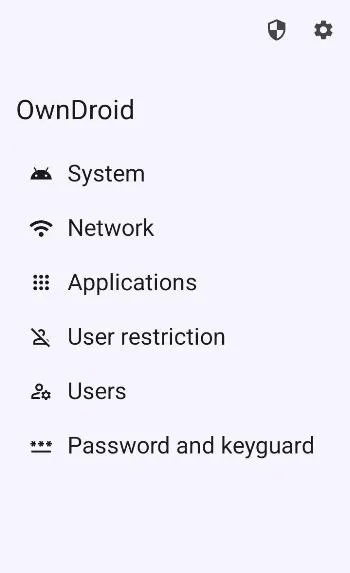
- System: disable the camera or screenshots, mute master volume, disable USB signalling, lock-task (kiosk) mode, wipe data.
- Network: add, change and delete Wi-Fi networks, network statistics, network logging.
- Apps: suspend or hide apps, block uninstallation, grant or revoke permissions, clear app storage, install and uninstall.
- User restrictions: disable SMS, outgoing calls, Bluetooth, NFC, USB file transfer, app installs and more.
- Users: create, start, switch, stop and delete users.
- Password and lock screen: reset the password, set the screen timeout.
How it gets its powers
OwnDroid needs a management role before it can do any of this. It supports several:
- Device owner (recommended). You can activate it with Shizuku, with Dhizuku, or with the ADB command
dpm set-device-owner com.bintianqi.owndroid/.Receiver. - Profile owner, in secondary users only.
- Work profile, which sets up a managed profile beside your normal apps.
Android is strict about device owner:
- It refuses if accounts are signed in on the device, and it also refuses if there are several users. You may have to remove your accounts temporarily, activate OwnDroid, then add them back.
- Only one device owner can exist. If another app already holds the role, deactivate it first.
- On most devices, a device owner blocks creating a work profile, because the system adds a restriction when it is set.
What stands out in the APK
- Shizuku API confirmed, and a Dhizuku permission is declared too. No trackers.
- Location is among the permissions that ask first. Android requires location access for Wi-Fi scanning, which the Wi-Fi management features rely on. Notifications is the other one that asks.
- 3.4 MB, the smallest app in our Shizuku list, with native code for all four CPU types.
Worth knowing
Device owner is powerful and a bit sticky. Read the project’s README before activating it, and make sure you know how to deactivate OwnDroid from inside the app. That is how you give the role back.
More apps that use Shizuku: Shizuku apps list.
What’s inside the APK
Trackers
No code matching the Exodus Privacy tracker signatures.
Native code
Runs on 64-bit and older 32-bit ARM phones.
Android versions
Built for Android 17 (target API 37).
Permissions
3 of them need your approval first.
Shizuku API. Uses the Shizuku API, so it can do ADB-level work without root once Shizuku is running. (rikka.shizuku.ShizukuProvider)
CPU types in this build: arm64-v8a (64-bit ARM, almost every phone since 2017); armeabi-v7a (32-bit ARM, older and budget phones); x86 (32-bit Intel, emulators); x86_64 (64-bit Intel, emulators and Chromebooks).
Asks you first (3)
Android shows a prompt before the app can use these.
- Approximate location · ACCESS_COARSE_LOCATION
- Precise location · ACCESS_FINE_LOCATION
- Show notifications (Android 13+) · POST_NOTIFICATIONS
You switch these on in Settings (1)
Special app access. Nothing is granted until you turn it on yourself.
- Install unknown apps · REQUEST_INSTALL_PACKAGES
Granted at install (7)
Low-risk permissions Android grants automatically, plus any we have not classified.
- ACCESS_WIFI_STATE
- CHANGE_WIFI_STATE
- FOREGROUND_SERVICE
- FOREGROUND_SERVICE_SPECIAL_USE
- QUERY_ALL_PACKAGES
- REQUEST_DELETE_PACKAGES
- USE_BIOMETRIC
Defined by other apps (4)
Permissions that belong to another app or to this app itself.
- com.bintianqi.owndroid.DYNAMIC_RECEIVER_NOT_EXPORTED_PERMISSION
- com.bintianqi.owndroid.MyPermission
- com.rosan.dhizuku.permission.API
- moe.shizuku.manager.permission.API_V23
More Information
- Package name
- com.bintianqi.owndroid
- Version
- 8.3.1 (build 47)
- File size
- 3.4 MB (3,381,555 bytes)
- Requires
- Android 6.0 or later
- Category
- System Tools
- License
- GPL-3.0-or-later
- Developer
- BinTianqi
- Source code
- github.com/BinTianqi/OwnDroid
- Released
- Aug 26, 2026
- Signer SHA-256
- e5d5db176a742c566ba6020ac24d93fabda5f6952d7fccae9e3a46e9848e83b5
- File SHA-256
- 7fc0808a8ee1401cf1f79010efde1d2511be36037725a9e32699595c6e6b8e98
- Checked
- , against the IzzyOnDroid index · how we check · verify it yourself
Common questions
Is this APK the official OwnDroid release?
Yes. It is the developer’s own release of OwnDroid 8.3.1, byte for byte as IzzyOnDroid distributes it. Its SHA-256 matches IzzyOnDroid’s signed index, and it is signed with the certificate IzzyOnDroid records for the app (SHA-256 e5d5db176a742c566ba6020ac24d93fabda5f6952d7fccae9e3a46e9848e83b5).
What Android version does OwnDroid need?
Android 6.0 or later (API level 23). Version 8.3.1 is built for Android 17 (target API 37). Runs on 64-bit and older 32-bit ARM phones.
Can OwnDroid access the internet?
No. The APK doesn’t request Android’s internet permission, so the app can’t go online by itself. In total it declares 15 permissions, and 3 of them need your approval first.
Does OwnDroid contain trackers?
No known trackers: our scan of version 8.3.1 found no code matching the Exodus Privacy tracker signatures. The scan covers known tracker libraries; it doesn’t show what data the app itself sends.
Is OwnDroid open source?
Yes. OwnDroid is released under the GPL-3.0-or-later licence, and its source code is published at https://github.com/BinTianqi/OwnDroid.
Recent releases
| Version | Released | Size | Requires |
|---|---|---|---|
| v8.3.1 · this download | Aug 26, 2026 | 3.4 MB | Android 6.0+ |
| v8.2 | Jun 6, 2026 | 3.3 MB | Android 6.0+ |
| v8.1 | Apr 6, 2026 | 3.2 MB | Android 6.0+ |
Versions currently kept in the IzzyOnDroid repository. We host and check only the newest one.